It is high time to think differently, to reconsider which persons and movements are worthy of cherishing.
John-Paul Himka
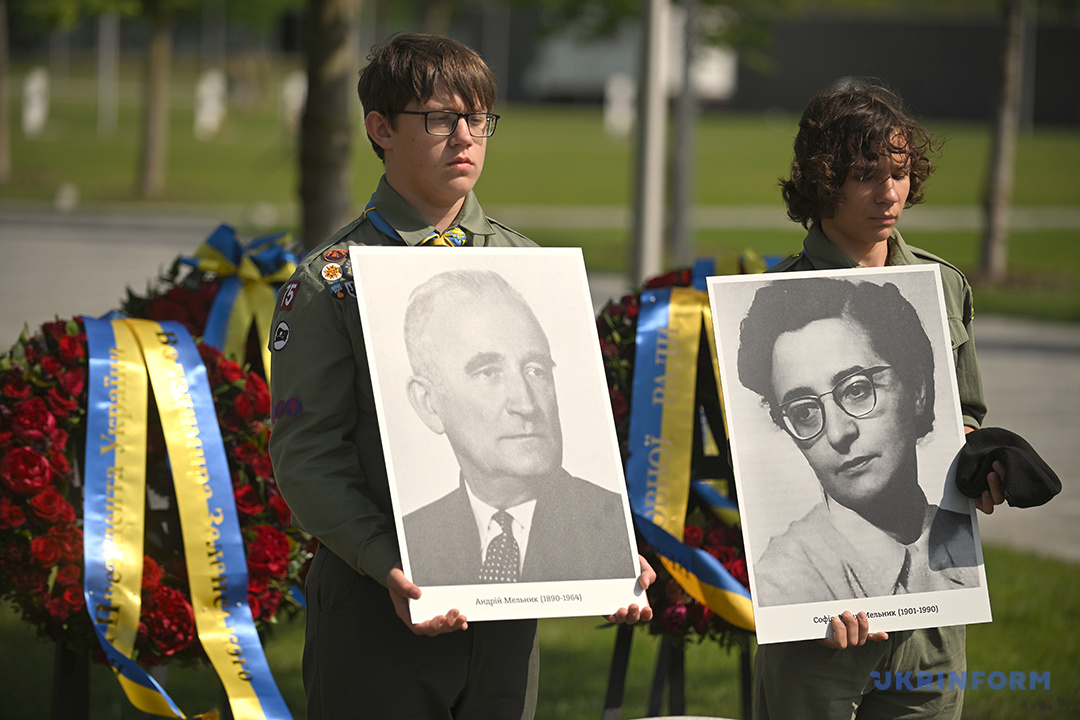
Andriy Melnyk was the leader of the entire Organization of Ukrainian Nationalists (OUN) in 1938-40 and of its Melnyk faction thereafter, until his death in 1964. He remained in his grave in Luxembourg until in late May of this year, when he was exhumed for a ceremonial reburial near Kyiv. On 22-23 May his coffin and that of his wife, Sofiya Fedak-Melnyk, lay in state in the Ukrainian Greek Catholic Patriarchal Cathedral of Christ’s Resurrection in Kyiv for the population to honor. Mrmorial liturgical services were celebrated over most of those two days. Then on 25 May, both bodies were ceremoniously reburied in the National Military Memorial Cemetery.
Melnyk was dedicated to the project of creating a Ukrainian state. During World War I he enlisted in the Austrian unit of Sich Riflemen (Sichovi stril’tsi), composed of Galician Ukrainians. Captured by the Russians, he managed to escape and join the armed forces of the Ukrainian People’s Republic. With the defeat of the latter, he joined with his close friend Yevhen Konovalets to continue the struggle, establishing the underground Ukrainian Military Organization in 1920. The Organization, perhaps better known by its Ukrainian abbreviation UVO, engaged in asymmetrical warfare against the Polish state — robbing post offices, sabotaging rail transport, and assassinating Polish policemen and officials as well as Ukrainians whom they regarded as collaborators with the Polish regime.
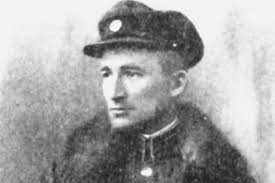
For his participation in the leadership of UVO, Melnyk was imprisoned by the Polish authorities from spring 1924 until February 1929. His treatment in prison was brutal. When he was released he stepped back from politics, although he remained a member of the leadership of UVO and the newly founded OUN. In the 1930s, he became manager of the estates of the Greek Catholic metropolitan of Lviv, Andrey Sheptytsky. In May 1938, Konovalets, the leader of OUN, was assassinated in Rottterdam. In his will, Konovalets named Melnyk as his successor.
People who knew Melnyk respected him. He was courteous and soft spoken, a gentleman, and a great contrast to the flamboyant and gesticulating Hitler and Mussolini, and these dictators’ imitators. During his service at the rank of otaman with Petliura’s army, he investigated the horrific pogrom in Proskuriv committed by the latter forces, and he issued harsh warnings to the troops that such crimes would be severely punished. So as a person and personality, Melnyk was a decent fellow.
But he is not being reburied and honored because he was basically a good guy. He is being inducted into the military pantheon because he was the leader of OUN. And plans are underway to disinter Konovalets, his predecessor as head of the Organization, and move his remains from Rotterdam to the military cemetery outside Kyiv for the same honors. Both Melnyk and Konovalets are political symbols, instantiations of OUN, which Ukraine honors as heroic.
What kind of politics is being honored here?
Melnyk was in charge of OUN when it revised its program in April 1939 at a conference in Rome, the Second Great Assembly of the Organization. It introduced a new position in its structure: Vozhd’, or Leader, a title equivalent to and modelled on the national socialist term Führer, the fascist term Duce, and the Ustaše term Poglavnik. The Leader would be a dictator during the war of Ukrainian liberation, the commander-in-chief of the armed forces, and – after victory – head of state. The new Ukrainian state would prohibit political parties, but OUN would guide it politically. The press would be controlled by the state and other hard-won freedoms curtailed.
A few months before the outbreak of World War II, Melnyk wrote to the German foreign minister, Joachim von Ribbentrop, that OUN was “related in world outlook to the same type of movements of Europe, in particular to national socialism in Germany and fascism in Italy.”
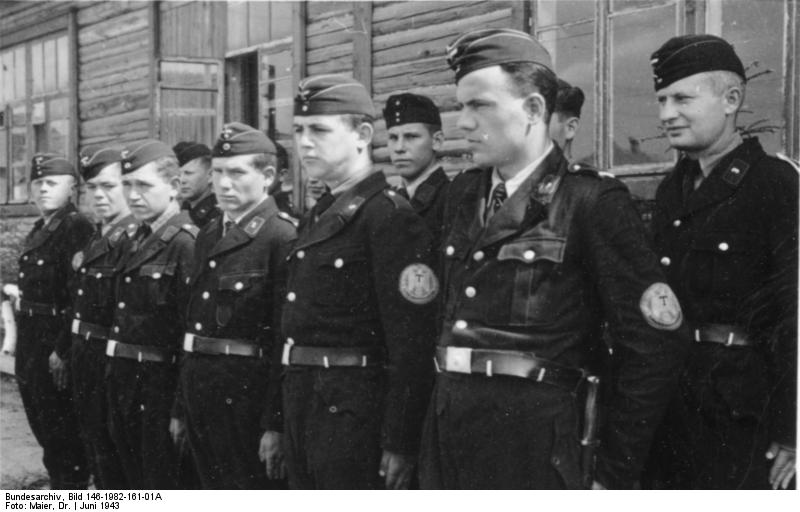
After Germany and its allies attacked the Soviet Union in June 1941, Melnyk was confined to Berlin and had little influence on his followers on the ground in Ukraine. Moreover, OUN had split in 1940, when Stepan Bandera contested Melnyk’s leadership. The Banderites took over the movement in most of Galicia, but Melnykites were the dominant force in Bukovina. The first major action of the Melnykites in Bukovina was to unleash a series of nightmarish pogroms against the Jewish population.
What kind of heritage is being promoted by the increasing OUNization of the Ukrainian state and society?
Part of that heritage is authoritarianism. Its promotion occurs at a time in world history when authoritarian leaders are in charge of the world’s most powerful states – Netanyahu, Putin, Trump, Xi – and when many other authoritarians have in the recent past or in the present been ruling in Brazil, Czechia, Hungary, the Philippines, and Venezuela. Why does Ukraine want to hallow this particular political form instead of democracy?
Another is an inversion of the history of World War II. Increasingly, collaborators with Nazi Germany are being honored – not just both factions of OUN but also the Waffen-SS Division Galicia – and the victory of the Red Army disparaged. This is certainly not how the rest of the world understands the Second World War. For all the murderous repression of Stalinist rule and the vile conduct of many Red Army soldiers, the Soviet Union was allied with the democratic nations – Britain, Canada, and the United States of America – against one of the foulest regimes in the history of humanity, i.e., Nazi Germany. The forces that the Ukrainian state has decided to honor may have involved at the most two hundred thousand Ukrainians, mostly from Western Ukraine. But over three million Ukrainians fought against Nazi Germany in the ranks of the Red Army and the Soviet Navy. Why does the tail now wag the dog?
And finally, why link Ukraine and its people to a heritage of mass murder? Both factions of OUN participated in the Holocaust, and the Bandera faction launched a brutal ethnic cleansing operation, creating their “Ukraine for the Ukrainians.” They also killed thousands of ethnic Ukrainians – Easterners, villagers who joined the collective farms, communists, POWs, teachers of Polish, Orthodox clergymen, and more.
It is high time to think differently, to reconsider which persons and movements are worthy of cherishing. None of the ideologues of OUN could touch the erudition and profundity of such Ukrainian political thinkers as Drahomanov, Lypynsky, or Rosdolsky. None of their writers approached the heights of a Shevchenko, Franko, or Rylsky.
We must forge a new pantheon, one that leads us forward, not into a blind and odiferous alley.
 Ukraine Solidarity Campaign (Кампанія Солідарності з Україною)