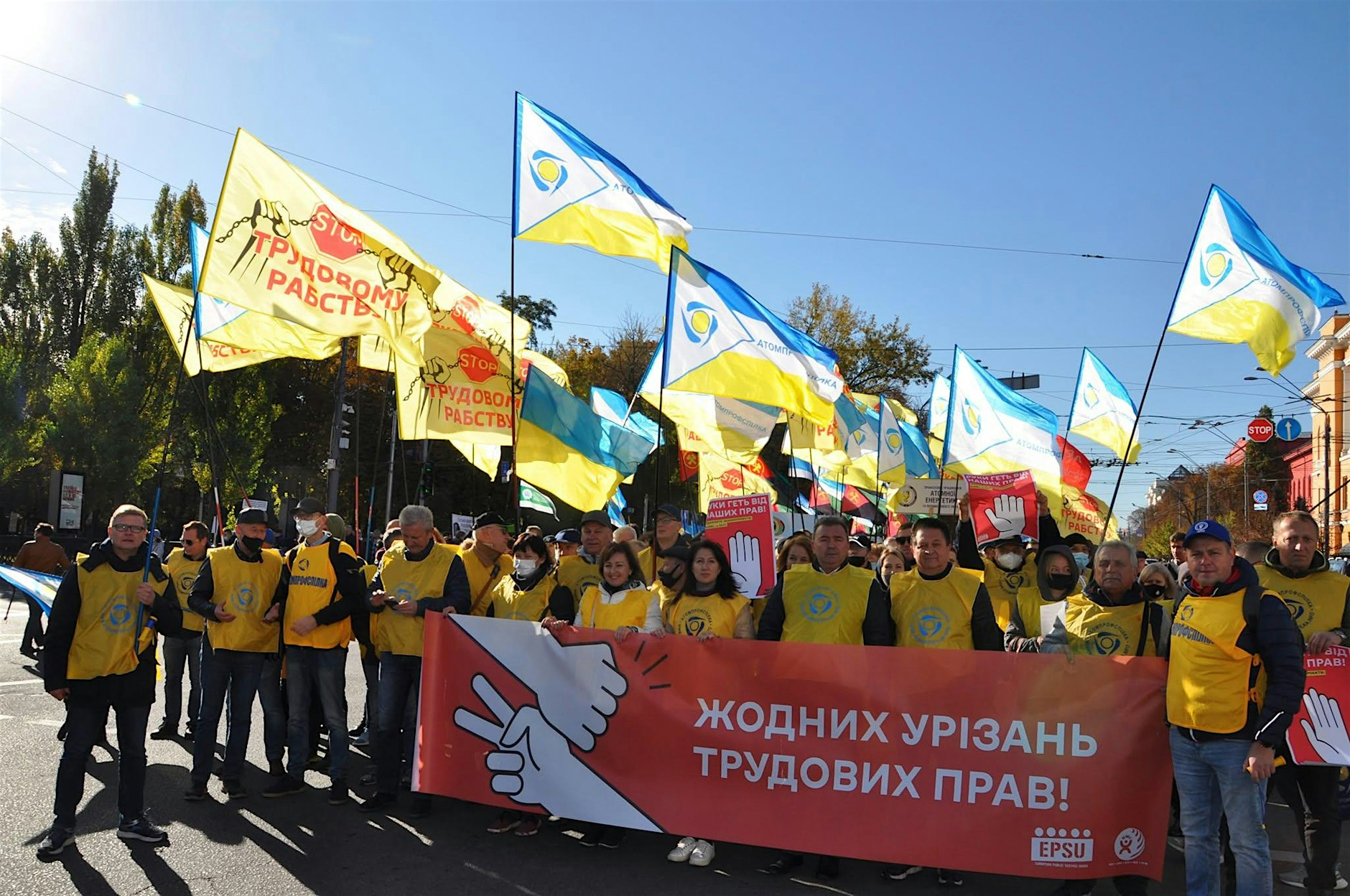
On 27 August two Ukrainian trade unionists, including a rep from the occupied Zaporizhzhia nuclear power plant, are speaking at UNISON HQ.
Eyewitness reports from Ukrainian trade unions under occupation and attack
Thursday 27 August, 5.45pm – UNISON national office, 130 Euston Road, London, NW1 2AY (ground floor).
Please register here for the meeting: free-the-zaporizhzhia-15
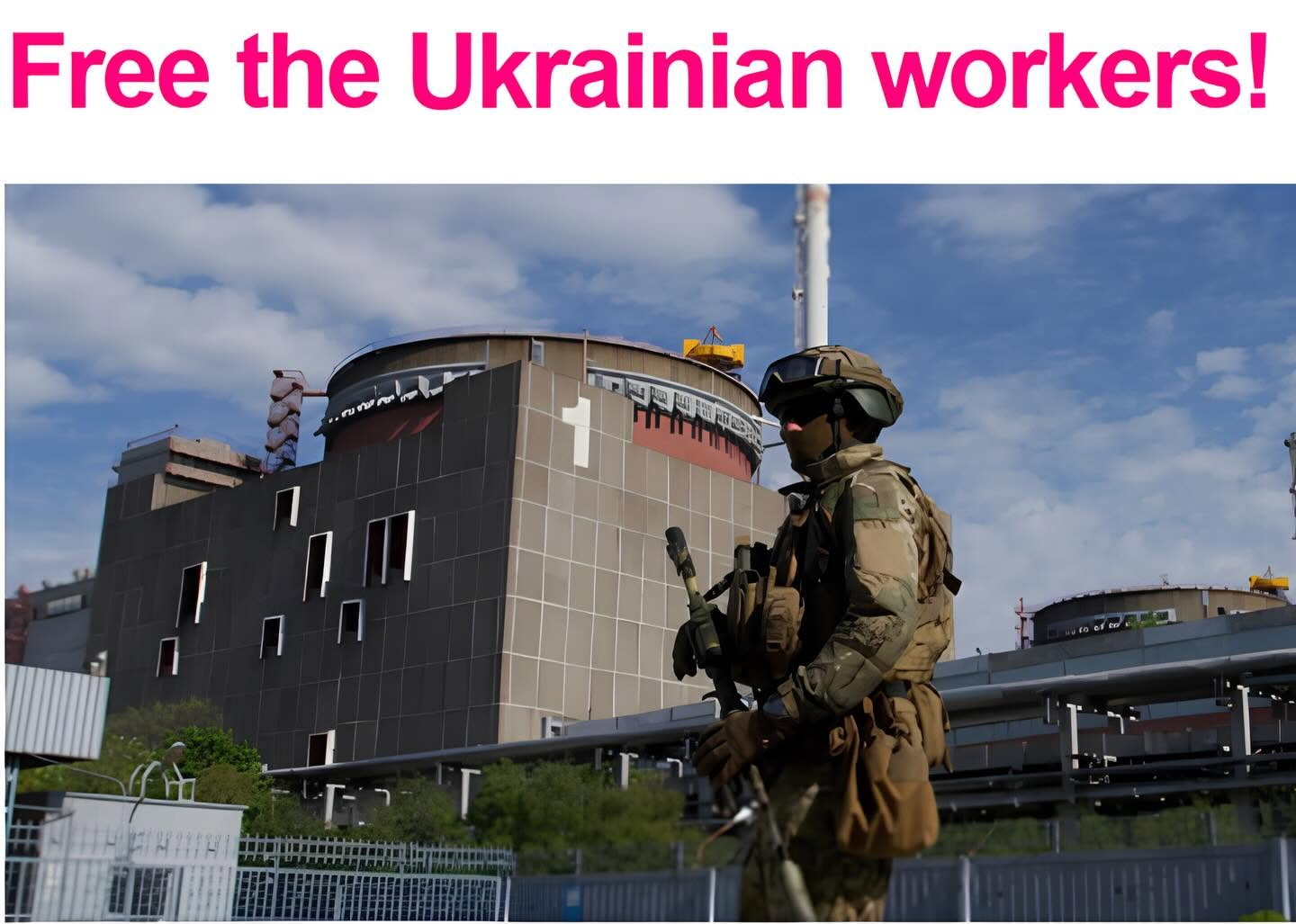
Fifteen workers at the Zaporizhzhia Nuclear Power Plant (ZNPP) – all members of the Atomprofspilka trade union – have been abducted, subjected to show trials, and sentenced to decades in prison on fabricated charges by the Russian occupation forces. (More here.)
Under occupation, ZNPP workers have faced coercion to accept Russian citizenship and sign new contracts. At least 1,000 have endured serious intimidation, physical and psychological abuse, or torture.
This persecution is part of Russia’s wider assault on the Ukrainian people, which has killed thousands of civilians and targeted workers across the energy, mining, health, education, rail, fire and rescue, and other sectors. Free trade unions in occupied areas have been supressed.
Ukrainian trade unions are appealing for international solidarity in the face occupation and missile attacks.
UNISON and the Ukraine Solidarity Campaign are hosting a rally to demand freedom for the imprisoned workers – including a union representative from the Zaporizhzhia plant who escaped the occupiers – and to strengthen solidarity with Ukrainian trade unionists facing invasion.
Speakers:
• Khrystyna Levchenko, Head of the Youth Organisation of Atomprofspilka and union representative at the Zaporizhzhia Nuclear Power Plant
• Ivanna Khrapko, Deputy Chair of the State Employees’ Union of Ukraine and President of the Youth Council of the Federation of Trade Unions of Ukraine
Chair: Chris Kitchen, General Secretary, National Union of Mineworkers (the NUM has submitted a motion on the Zaporizhzhia workers and solidarity with Ukraine to TUC Congress in September)
Published below from is the report of a recent talk by Khrystyna Levchenko,publsihed by Atomprofspilka .
The Situation at the Occupied Zaporizhzhia Nuclear Power Plant and in Enerhodar Discussed in The Hague
On 5 July, the Parliamentary Support Team for Ukraine (PSTU) of the OSCE Parliamentary Assembly held a meeting at the World Forum in The Hague. The event focused on war crimes, crimes against humanity, and acts of genocide committed by the Russian Federation in the temporarily occupied territories of Ukraine. With the support of the NGO Association of Relatives of Kremlin Political Prisoners and Truth Hounds, one of the invited speakers was Khrystyna Levchenko, a representative of Atomprofspilka.
In her address, she presented to international parliamentarians the reality of life and work at Europe’s largest nuclear power plant following its seizure by Russian forces. Her testimony was based not only on documented facts but also on her own experience. Having lived in occupied Enerhodar for some time, she personally witnessed how Russian troops transformed a civilian nuclear facility into a military base.
During her speech, she emphasized that before the full-scale invasion, more than 11,000 people worked at the Zaporizhzhia Nuclear Power Plant. Today, the majority have been forced to leave the city, and the plant is experiencing a critical shortage of licensed personnel. Before the war, the plant employed 159 licensed specialists; today, only 22 remain. This is not merely a staffing issue but a serious threat to nuclear safety across Europe. As Khrystyna stressed, there can be no safe operation of a nuclear power plant under the barrel of a gun. Employees working under constant psychological pressure cannot maintain the safety standards required by the International Atomic Energy Agency (IAEA).
The participants’ attention was also drawn to the fate of illegally detained civilians from Enerhodar and workers from the energy sector. Among those imprisoned are 14 employees of the Zaporizhzhia NPP, two former plant employees, workers of the Zaporizhzhia Thermal Power Plant, healthcare professionals, teachers, municipal workers, and trade union activists. Many have been sentenced to lengthy prison terms on fabricated charges of “espionage,” “terrorism,” or “treason,” while others continue to be held incommunicado without any contact with the outside world.
Another key part of the presentation addressed the systematic destruction of Ukrainian identity in the occupied territory. The Russian occupation authorities have removed Ukrainian textbooks from schools, destroyed books by Ukrainian authors, rewritten educational curricula, imposed Russian history and culture, and actively involved children in militarized organizations and military-patriotic programmes. As Khrystyna Levchenko emphasized, this is no longer simply an occupation – it is a deliberate attempt to erase the Ukrainian identity of future generations.
Concluding her remarks, she called on the OSCE Parliamentary Assembly to maintain international pressure on the Russian Federation, seek the release of all unlawfully detained civilians, ensure the protection of Zaporizhzhia NPP employees and their families, and support the right of Ukrainian children to preserve their language, culture, and national identity.
Importantly, during the Annual Session of the OSCE Parliamentary Assembly, a draft resolution on Russia’s crimes against Ukraine was considered, which specifically referred to the civilian hostages from the Zaporizhzhia NPP and Enerhodar. The resolution condemns the unlawful detention, torture, and enforced disappearance of plant employees and residents of the occupied city, and calls on the Russian Federation to immediately and unconditionally release all unlawfully detained civilians.
We express our gratitude to everyone who works tirelessly every day to advance this issue and bring the plight of the unlawfully detained civilians of Enerhodar to international platforms. For Atomprofspilka, this represents an important outcome of many years of advocacy. Behind every statistic are real people –workers of Ukraine’s nuclear industry, their families, and the residents of Enerhodar, who have lived under occupation, repression, and constant fear for more than four years. Their voices were heard in The Hague, and the issue of unlawfully detained civilians received even stronger international attention.

 Ukraine Solidarity Campaign (Кампанія Солідарності з Україною)