
John-Paul Himka
In this installment of my memoir, I want to talk about health and hygiene.
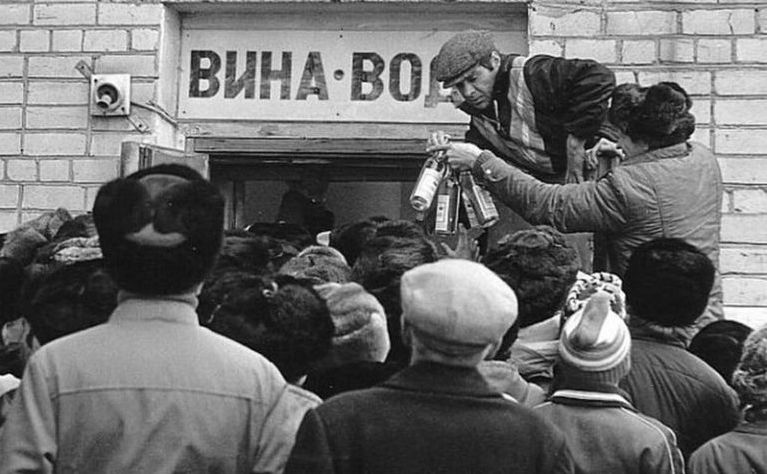
Men drank a tremendous quantity of vodka. A joke from the time was: What’s the philosophical definition of nothing? Answer: a liter of vodka split four ways. I knew a prominent poet who liked to start his day with a couple of shots, no doubt chasing away the hangover from the previous night’s tippling. This was not new to me. I had seen double shots of vodka as breakfast pick-me-ups in Polish cafes in the mid 1970s and had been treated to breakfast vodka by relatives when I first stepped foot in Ukraine in 1976. In that same period I had also seen workmen enter a cafeteria in Leningrad and drink vodka from six-ounce glasses.
There was a powerful taboo against drinking alone, so Ukrainians addicted to alcohol would seek any excuse to bring out a bottle when a male guest entered their home. Sometimes you passed a man squatting or sitting on the street or alleyway looking for a drinking companion. As you passed, he would put his fingers to his throat, sign language for “join me for a drink.” A bottle of vodka cost much less than a bottle of wine. The massive intake of spirits contributed to a low life expectancy. In 1983, the life expectancy in the Soviet Union was 68; in Canada in that same year, it was 76. Statistically, women always live longer than men, but the differential in the USSR was larger than the norm. Men lived, on average, 63 years, while women lived a full ten years longer. In Canada at the same time, women lived seven years longer than men.
It’s no wonder that all the leaders of the Soviet Union from 1982 until the end – Yurii Andropov, Konstantin Chernenko, and Mikhail Gorbachev – launched anti-alcohol campaigns. These proved fruitless in combatting alcohol addiction. These campaigns always resulted in sugar shortages, as men distilled their own spirits in makeshift apparatuses at home. The campaigns also led to the destruction of vineyards, from which Ukraine – whose climate made it a major wine producer in the USSR – took decades to recover. And in fact, the destruction of vines was quite counterproductive. If one travels to Ukraine today, one sees much less vodka consumption, replaced by more moderate consumption of beer and wine. Making the latter two products more available seems to have made a significant difference in the drinking culture. However, as a result of the Soviets’ war in Afghanistan (1979-89) opiates began to filter into the USSR, introduced by veterans and picked up by alienated youth.
In public places and institutions, the toilets were generally a hole in the ground with two pads on which to rest your feet as you squatted. Squatting is probably a healthier way to eliminate waste than sitting on a flush toilet, but Westerners were not comfortable with these Soviet facilities, especially since they could become very dirty. Outhouses continued to serve as toilets in rural localities. Trains had sit-down toilets, but since much of the population was not used to or distrusted them, people tended to lift the seat and squat over the rim of the toilet. The movement of the train, combined with alcohol consumed to while away the time, resulted in messes and taught the prudent to visit the toilets earlier rather than later in a trip.
Toilet paper, as we understand it, was hard to come by. Generally, people used newspaper to wipe themselves, and – since the plumbing was unable to handle paper – they tossed their used bits of newspaper into an uncovered dustbin in the toilet cubicle. Sometimes, rarely, a truck would pull up on the street and sell rolls of toilet paper. Lines would form instantly, and one could see happy consumers walking around with a string necklace of toilet-paper rolls. This toilet paper tended to be rough and crinkly, but still highly prized, and saved for the right moment. When guests were expected, hosts would put a roll of toilet paper in the bathroom. (If they had a private bathroom in their apartment – some apartment houses had shared toilets.) One time a truck pulled up and sold toilet paper in square sheets, maybe 4 x 6 inches. I loaded up. Unfortunately, I discovered that this type of toilet paper was not absorbent. However, the sheets proved very handy for taking notes.
Medical care was free in the Soviet Union, and this contrasted sharply with the medical industry in the United States, where I grew up. But the USSR’s socialized medicine was not of Canadian or European caliber. Combined with alcohol addiction and nutritional deficiencies, substandard health care kept the life expectance in the country relatively low. Although treatment, medicine, and hospitalization were, in theory, completely free of charge, the reality was somewhat different. It was common practice for Soviet patients to pay doctors, in money or in kind. There were no formal charges, and I understand that discovering how much you were expected to pay resembled a complicated mating dance between birds. It was beyond the ken of a foreigner like me. Medicines were free or almost so, as long as they were available locally; but more specialized medicines sometimes had to be imported from abroad, which was not easy to accomplish given the USSR’s paranoia about connections with foreign countries. My wife and I used diplomatic mail to bring in medicine for one person suffering in the hospital. We didn’t know him from Adam, but the grapevine and networks had found us and told us the medicine that was required.
If you needed to stay in a hospital, you had to bring your own bedding. You could, I suppose, eat whatever gruel the hospital might have served, but I never saw anyone doing it. More commonly, family and friends brought homemade soups and other dishes to feed their dear ones. My wife and I experienced the deficits of the hospital system at first hand. Chrystia had become pregnant in Lviv but had a miscarriage during her first trimester. It is normal practice to scrape the uterus after a miscarriage; the operation is known as a D and C. I was in the hospital waiting for Chrystia, a floor or two below where she was being treated. Suddenly, I distinctly heard a piercing, unearthly scream that I recognized came from her. The cause of her scream and my alarm was that the D and C was performed without an anaesthetic. This would never have happened in a hospital back home, and the experience left us with a negative view of health “care” in the Soviet Union. People really didn’t count for much.
 Ukraine Solidarity Campaign (Кампанія Солідарності з Україною)