
John-Paul Himka
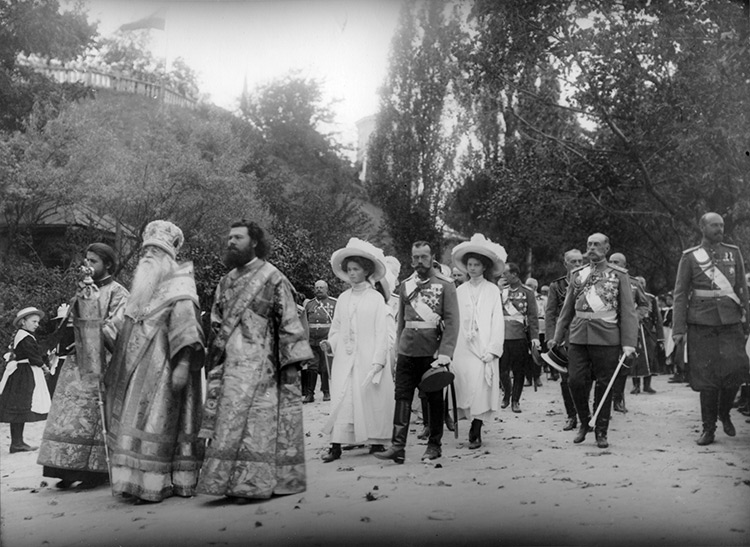
Tsar Nicholas II walks in the grounds of the Monastery of the Caves in Kyiv, 1911.
Although many people think of Ukraine as part of Russia, Russia did not aquire any territories inhabited by Ukrainians until the late seventeenth century, in the aftermath of the cossack rebellion against Poland that erupted in 1648. At that time Russia took Kyiv and Left-Bank Ukraine, that is, Ukrainian territories east of the Dnipro River. In 1793 and 1795, Russia took much of the Right Bank from the Polish-Lithuanian Commonwealth, which disappeared after partition by its neighbors. The remaining Ukrainian-inhabited territories all ended up in the Habsburg monarchy: Galicia, Bukovina, and Transcarpathia.
When Ukrainians were first incorporated into Russia, they were understood to be valuable experts by some Russians, and nefarious heretics by other Russians. Still under Poland-Lithuania, Ukrainians had founded a number of schools that combined the Polish variant of European civilization with the traditions of Orthodox Rus’. The most famous of these was the Kyivan Mohyla Academy founded in 1632. These schools not only created a Ukrainian intellectual elite but influenced education and theology throughout the Orthodox world. At first Russian theologians and churchmen were deeply suspicious of the new learning and the corrected liturgical texts that emanated from Kyiv. In fact, rejection of these Ukrainian influences was a major factor in the schism in the Russian church that created the Old Believers. But once Ukrainians were absorbed into the Russian tsardom, they dominated episcopal posts in the country and became professors in newly founded institutions of higher learning following the Western model. They also played an outsized role in Russian musical life, since they had brought with them a kind of choral polyphony hitherto unknown in Russia. In short, Ukrainians brought the first breath of European culture into Russia. Later the Russian tsars and tsarinas would tap into European trends more directly, marrying into German royalty, recruiting European engineers and military officers, and introducing the French language and French fashions into the court.
In the late eighteenth century, the role of Ukrainians was considerably reduced. There were still ethnic Ukrainians in high office and they still played some role in Russian intellectual life, but they were also assimilating to the rapidly developing, modernizing all-Russian culture. When the cossacks had entered Russia in the mid-seventeenth century, they enjoyed some territorial autonomy, but that was whittled down by Tsar Peter I and completely abolished by Tsarina Catherine II. The former cossack officer class spent much of its energy in the late eighteenth and early nineteenth century trying to obtain documents granting entrance into the Russian nobility. Although the former cossack elite could still speak to their serfs in the Ukrainian vernacular, they communicated among themselves and with others in the Russian language. Just as during the centuries Ukrainians spent within Poland-Lithuania, the elite migrated culturally away from the Ukrainian masses and assimilated into a foreign elite.
There was no discrimination against educated Ukrainians, or for that matter Belarusians, who joined the Russian elite. By the early nineteenth century, they were considered to be Russians, of course with their ancient and quaint peculiarities, but still Russians. They were indeed considered rather fashionable Russians. Nikolai Gogol (Mykola Hohol) entertained all of Russia with his stories of life in small-town Ukraine. Ukraine’s greatest poet, Taras Shevchenko, was almost universally lauded by Russian intellectuals, at least until his arrest in 1847.
But by the mid-nineteenth century, the Russian state began to view Ukrainian specificity as something dangerous. Ukrainians were producing an interesting literature in their own language, and various secret Ukrainian political organizations began to be formed, notably the Cyril and Methodius Brotherhood (est. 1845) and the Hromada of Kyiv (est. 1859). The Russian tsardom, which was the guarantor of Reaction in Europe in the wake of the revolutions of 1848, decided to clamp down decisively on the Ukrainian movement. It restricted publication in the Ukrainian language by decrees of 1863 and 1876 and completely banned the Ukrainian language from the rather poorly endowed educational system. Ukrainian activists were arrested and exiled. From the mid-nineteenth century until the Russian empire collapsed, the Ukrainian movement and the Russian state were mortal enemies. Ukrainians aligned themselves with Russian democrats and revolutionaries and with other persecuted minorities. They were among the forces that brought down the tsarist autocracy in the spring of 1917.
 Ukraine Solidarity Campaign (Кампанія Солідарності з Україною)