Prof Bill Bowring, Birkbeck College, Barrister

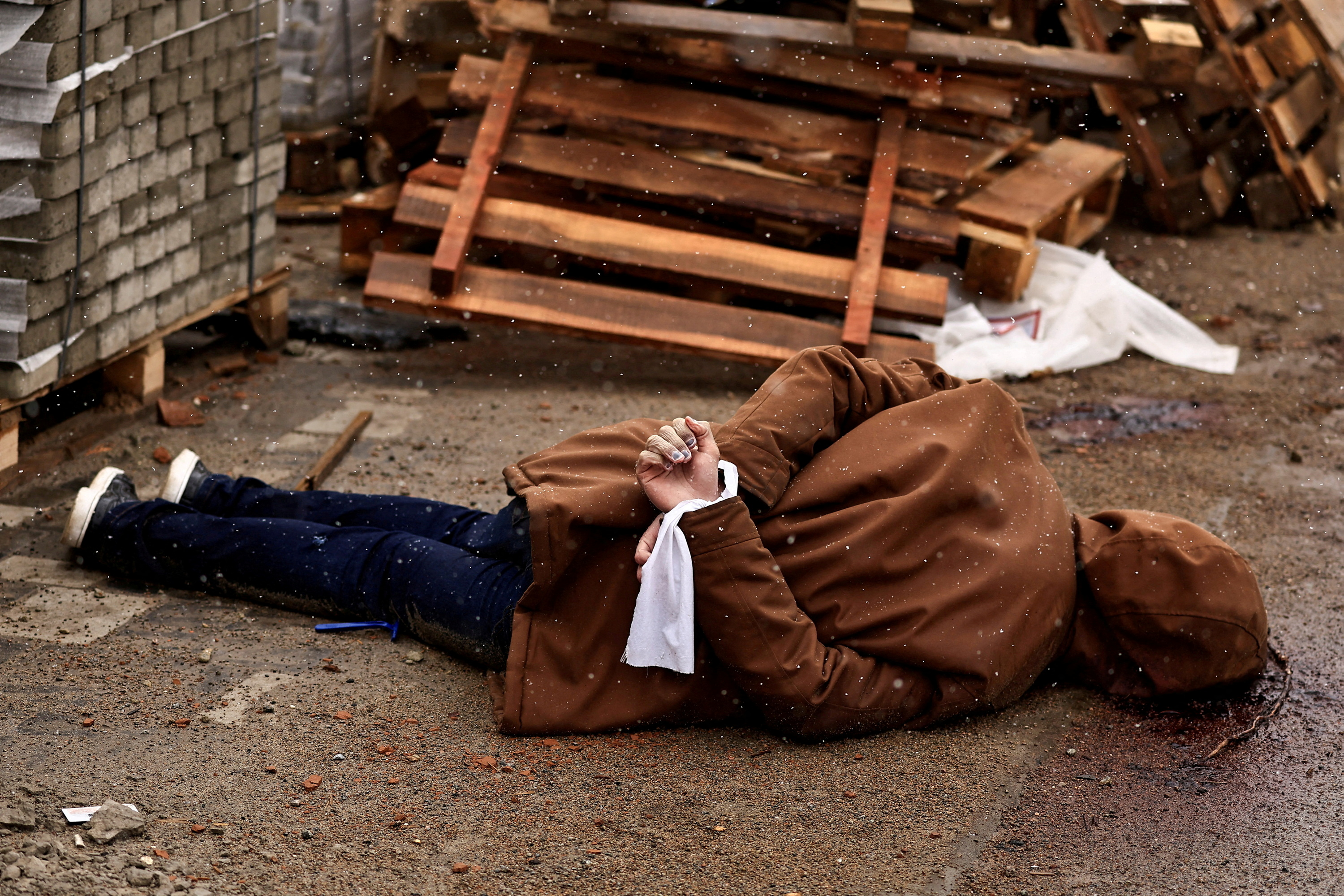
Russia has been committing a wide variety of heinous war crimes since its all-out invasion of Ukraine, starting on 24 February 2022. These have been documented by many human rights organisations.
On 2 March 2022, the Prosecutor of the International Criminal Court (ICC), Karim Khan KC, announced he had opened an investigation into the Situation in Ukraine on the basis of the referrals received. The scope of the situation encompasses any past and present allegations of war crimes, crimes against humanity or genocide committed on any part of the territory of Ukraine by any person from 21 November 2013 onwards. The ICC has a team investigating war crimes committed in Ukraine.
On 17 March 2023, Pre-Trial Chamber II of the ICC issued warrants of arrest for two individuals in the context of the situation in Ukraine: Vladimir Putin and Ms Maria Lvova-Belova (the Russian children’s ombudsman), for the war crime of unlawful deportation of population (children) and that of unlawful transfer of population (children) from occupied areas of Ukraine to Russia. The crimes were allegedly committed in Ukrainian occupied territory at least from 24 February 2022.
Russia is highly unlikely to surrender unconditionally, as was the condition for the Nuremberg trials, and it is equally unlikely that Putin will find himself in the dock at the ICC in The Hague. But the arrest warrants can be seen as a smart move by the Prosecutor, since Putin freely admits the allegations against him, states sympathetic to Russia have become less so, and Putin cannot travel to any jurisdiction where he might be arrested.
But it is notable that the Prosecutor has since 2021 also been carrying out an investigation into war crimes committed in the Occupied Palestinian Territories and Gaza, but so far there have been no indictments or warrants for arrest.
I been asked by USC to write a blog post on “justice for war crimes”. By “justice”, many people mean “revenge”, pure and simple. In the case of war crimes what is meant is the identification, prosecution, conviction and punishment of the perpetrators. The ICC exists to prosecute individuals for war crimes.

The ICC is not part of the United Nations. Like the Geneva Conventions of 1949 and their Additional Protocols of 1977, it was created by the International Committee of the Red Cross, based in Switzerland. On 17 July 1998, 120 States adopted the Rome Statute, the legal basis for establishing the permanent ICC. The Rome Statute entered into force on 1 July 2002 after ratification by 60 countries. 123 states out of 193 members of the United Nations are now members of the ICC, including the UK. But the USA, Russia, India and China – and Israel – are not members. The ICC is therefore hamstrung in a way similar to the UN Security Council, with its five Permanent Members, the victors in WW II, having the right of veto. The United States energetically concludes treaties with as many states as possible, so that US citizens can never be prosecuted for crimes committed on the territory of states which are members.
To repeat, war crimes can be committed by the citizens of any state, if committed on the territory of a state which is part of the ICC system. For example, Ukraine and the State of Palestine.
What are war crimes?
Laws of war, laws of armed conflict, go back to the start of recorded history. In particular the principle that combatants who are wounded or otherwise hors de combat, or who have surrendered, should be spared. The reason is simple. In warfare, neither side can be sure that it will win. Better to lose, and survive, perhaps to fight another day.
But prosecution of individual perpetrators for war crimes is much more recent.
The Nuremberg trials of 1945-46 were only possible (I emphasise) because of Germany’s unconditional surrender on 8 May 1945 to the allied forces of the USSR, which got to Berlin first, the USA, Britain and France.
The German accused were tried for the new crime of against peace (aggression), developed by the Soviet jurist Aron Trainin; war crimes, which already existed in international law as criminal violations of the laws and customs of war; and the new crimes against humanity, since war crimes did not apply to a government’s treatment of its own citizens. The USSR, Britain and the USA agreed that crimes against humanity included “murder, extermination, enslavement, deportation, and other inhumane acts committed against any civilian population”.
Genocide became an international crimes with the Genocide Convention of 1948. And war crimes were codified by the Red Cross in the four Geneva Conventions of 1949. Geneva Convention I for the Amelioration of the Condition of the Wounded and Sick in Armed Forces in the Field; Geneva Convention II for the Amelioration of the Condition of Wounded, Sick and Shipwrecked Members of Armed Forces at Sea; Geneva Convention III relative to the Treatment of Prisoners of War; and Geneva Convention IV relative to the Protection of Civilian Persons in Time of War. The four 1949 Conventions have been ratified by 196 states, including all UN member states, both UN observers (the Holy See and the State of Palestine), as well as the Cook Islands. The Conventions were strengthened by two Additional Protocols in 1977. 174 States are party to Additional Protocol I which reinforces the GC IV to the benefit of victims of international armed conflicts. 168 States are party to Additional Protocol II which relates to the protection of victims of non-international armed conflicts.
All States parties to the Conventions are required to make them part of their own domestic law, in the UK the Geneva Conventions Act of 1957. Each Convention contains “grave breaches” with criminal liability, and these are crimes of “universal jurisdiction”. States are under an obligation to prosecute anyone of any nationality who commits grave breaches anywhere, if that person is on their territory. But a warrant issued by the London court in 2008 to arrest Israeli General Almog on his visit to the UK, for the crimes of ordering the demolition of 59 Palestinian homes, failed as the general was tipped off and was able to return home.
The failure of these “universal jurisdiction” laws was part of the impetus for the 1998 Rome Statute of the ICC.
It is not possible to prosecute Putin for the most serious crime, aggression, because this crime was only added to the ICC’s jurisdiction in 2018, and an individual can only be prosecuted for the crime of aggression if they are a national of a state that has signed up to the Court’s statute. So not Russia.
Individual prosecutions for the crime of genocide require proof of genocidal intention, and there have been very few convictions, in cases concerning Former Yugoslavia and Rwanda, in the Tribunals established by the UN Security Council, which have now completed their work. Their case-law is now part of the ICC’s case-law.
I repeat again that the Nuremberg trials were only possible because of Germany’s unconditional surrender. They can be criticised as “victor’s justice”, as there were no prosecutions of Churchill or “bomber Harris” for the fire bombing of German cities; or of Truman for Hiroshima and Nagasaki.
There are private initiatives for the prosecution of Putin and others, but these will have even less teeth than the ICC. In the end, Ukraine must be assisted in every way to maintain its heroic resistance to Russian aggression, and Putin is in an increasingly dangerous situation, for himself and for Russia. He thought he would have a victorious “five day war” in Ukraine, as he did in Georgia in 2008, when the Georgians ran away. If asked, I would have advised him that to take on Ukrainians was a very bad idea.
 Ukraine Solidarity Campaign (Кампанія Солідарності з Україною)