
By Stephen Velychenko
Comments on Ilya Budraitskis: “Putinism as New Form of Fascism?”
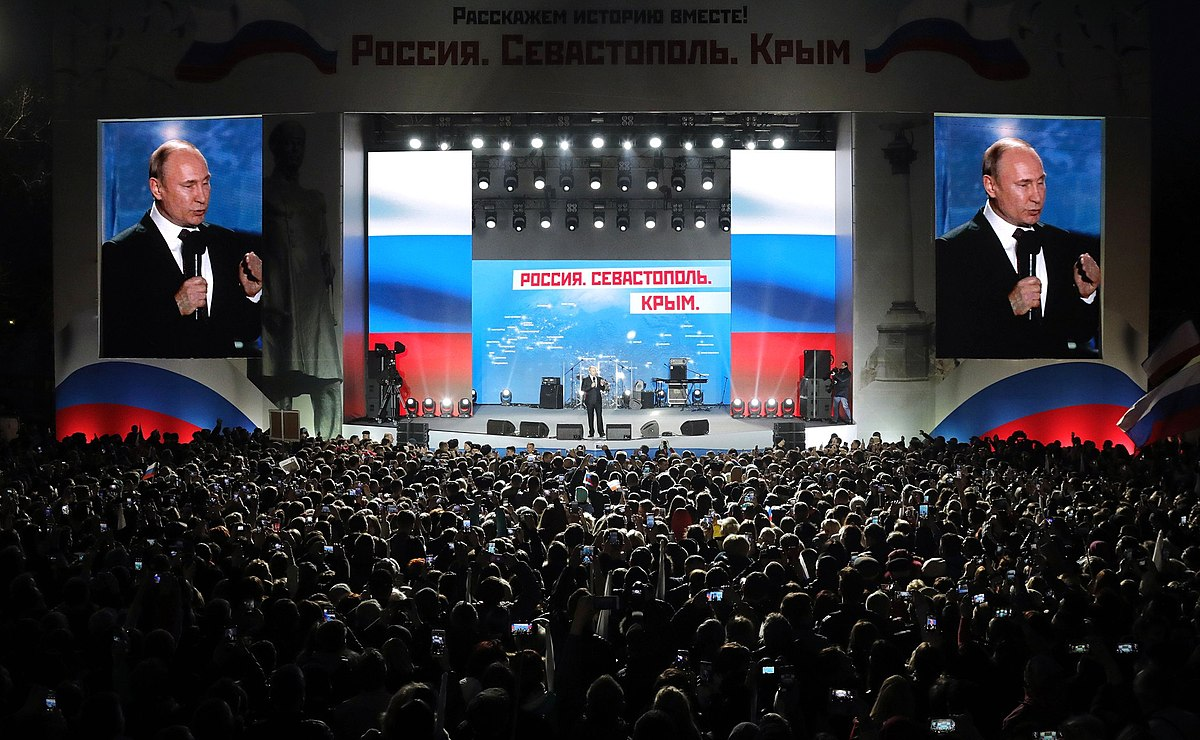
There can be no doubt that as of 2004 Putin, his secret police cronies and associated marginal ideologues like Dugin and Zhirinovsky, had created an authoritarian dictatorship in Russia. Some like Budraitskis characterize this regime as fascist. If this characterization was applicable before 2014, it is quite inapplicable after 2014 and Russia’s invasion of Ukraine. The Putin regime after 2014 cannot be compared to the fascist governments of Latin America or of interwar Europe. It can only be compared to Hitler’s Nazi regime. Budraitskis. compares Putin to Hitler, but what he identifies as common traits exclude those which made Hitler’s and Putin’s dictatorships much different from fascist dictatorships.
Unlike the fascism of Salazar, Franco or Mussolini, the various eastern European and Latin American dictators, Hitler’s Nazism was something unique in world history. It claimed one nation was better than all others and had a mission to dominate all others. It glorified war, and abolished non-government institutions standing between the population and the government. It had a death cult, and sought to physically annihilate entire ethnic/national groups because of who they were. Hitler allotted himself the right and duty to protect all Germans wherever they resided. He pursued an aggressive foreign policy invading and annexing neighboring states. Nazism justified mass murder of harmless civilians and establishment of huge networks of concentration camps. Putin’s clique does not aspire to world domination nor have they re-established Stalin’s Gulag. What they have done, like the Nazis, is claim their country is special and has a mission. They invaded and occupied a foreign state. Putin allotted himself the right and duty to protect not only Russians but even Russian-speakers in whatever country they reside. Putin’s officials glorify war, created a death cult, and call for the physical extermination of Ukrainians. In light of these characteristics, the Putin regime as of 2014 cannot be classified as fascist. Because of the above noted traits it evolved into a Russian form of Nazism. Fascism is not a synonym for Nazism nor should it be used to designate any and all rightist authoritarian regimes – as did Stalin, his associates, and foreign sympathizers. Perhaps because Budraitskis was raised and educated in a country where the government promulgated this confusion, he did not think twice about it and bother to confront it.
One must also question Budraitskis repeating the idea that societies with private ownership of the means of production called capitalist, will inevitably evolve into some kind of fascist dictatorship. This is absurd. It as absurd as the idea that societies with government or social ownership of the means of production must inevitably become some kind of Stalinist dictatorship. Regardless of the nature of property and production relationships, dictatorships are created by leaders making conscious political decisions; not obscure intangible “historical forces.”
What Budraitskis, like all too many today ignore or forget, is the impact of national bourgeois democratic revolutions on societies between 1776 and 1848. Where such revolutions occurred they established representative democracy, rule of law, freedom of speech, freedom of belief, freedom of the press and by 1914, the beginnings of the welfare state. In England, these “bourgeois” liberties were attained by reform. Budraitskis implies these achievements are “false” and “facades.” He equates Anglo-American neoliberal capitalism with fascism! Another absurdity. While corporate leaders and their paid apologists may well desire a perfect corporate totalitarian controlled society, that is unlikely to happen in countries where people like Budraitskis use the freedoms that exist there to oppose such efforts – assuming humans have agency and are not mere playthings of “forces.” These liberties arguably can be expanded and extended in societies where they have long existed. Societies wherein they have only recently been introduced, should be supported as “progressive” — not rejected on the grounds such liberties are only “facades” or incomplete as compared to the liberties prevailing in long established liberal capitalist states.
These liberties laid the basis for the Keynesian social-democratic order that characterized post war North America and western Europe – with its mixed-economy, strong middle-class, strong unions, high wages, high corporate taxes, and high rates of profit. After 1989 these freedoms were established in eastern Europe. In Ukraine, they were established in 2014. Russia’s “bourgeois” democratic revolution of 1917 was terminated by the Bolsheviks. It was terminated again after 1991 by former communist party activists and secret police operatives ably exploiting the misery introduced into Russia by the hordes of American neoliberal capitalist advisors led by men like Larry Summers and Jeffrey Sachs, their bankers and lawyers who all flocked to Russia hoping for vast profits. These “Harvard Boys” and various other proponents of “Chicago School” and “Washington Consensus” type capitalism ensured there would be no Keynesian social democratic welfare state in the former USSR. They helped party officials and KGB agents steal public assets and smuggle Russia’s wealth into foreign banks and offshore accounts making fortunes in fees in a fine example of the international solidarity of the capitalist class. Yet, it is also the case that thanks to US EU “bourgeois” liberties and freedoms capitalists like Bill Browder can take corporate criminals to court in the EU and US, with their “facades” of rights and privileges, and thanks to those “facades” find and recuperate the billions they have stolen. Those same “facades” allow the Ukrainian government to find and return the billions its pre-2014 politically Russophile oligarchs stole from Ukrainians. Justice among thieves? Maybe so. But is it preferable to be able to choose between a panoply of gangsters, or to live under one capo de tutti controlling everything? Do capitalists like Bill Browder want to rid the US and EU of their “facades” and establish fascist dictatorships?
What emerged in Russia after 1991 is a form of neoliberal capitalism that is radically different from US and EU neo-liberal capitalism. That difference is defined by the absence of the “false facades” of “bourgeois” democratic freedoms listed above, which Budraitskis dismisses on the facile assumption that all capitalism is the same. These are freedoms that make opposition possible to the depredations of neoliberal capitalism, make possible its demise, and explain why people flee oppression and persecution to the US and the EU – not to Russia, or Cuba, or North Korea, or China. The US EU corporate controlled neoliberal capitalist order with its fringe nazi-loonies can be considered an evil. But it is a lesser evil to the Russian oligarch controlled neoliberal capitalist order wherein the fringe nazi loonies rule the country.
This nuance is missing from the Budraitskis analysis, as is another matter of particular relevance as concerns Putin’s invasion of Ukraine. Namely, the dispute between Kautsky and Lenin during WW1 about the nature of capitalism and imperialism. Kautsky claimed a single capitalist world order was emerging called Ultra-capitalism wherein the great powers would in the end agree to divide small countries among themselves and share peacefully the world’s resources. In the 1980s this dream was reincarnated by US rightist thinkers and their corporate sponsors in the so-called “Project for the New American Century” which leftists oppose and condemn as “American imperialism.” Lenin, however, disagreed with Kautsky. He pointed out that capitalist rivalry would never end and that astute socialist politics involved playing-off the rivals against each other. This implied that there was a lesser evil socialists could chose when looking for allies.
In such a context, caught between the great capitalist powers, leftists in small countries have a choice that those in the great powers must recognize – but usually do not. People in small countries can support parties advocating radical socialist autarchy—which we today know leads nowhere as the Bolshevik experiment, Cuba, Ethiopia and North Korea today demonstrate. Or, they can support moderate “bourgeois” politicians advocating alliance with a distant lesser evil against an immediate greater evil. All too many with leftist-socialist sympathies today, however, have not only forgotten Lenin’s observation about the reality of inter-capitalist rivalry. They also confuse anti-imperialism with anti- Americanism. Such people consequently are not only blind to Russian and Chinese imperialism, but actually support them because they are anti-American. Vociferous in defence of those who prefer not to be in the American imperialist “sphere of influence,” such leftists do not defend those who prefer not to be in the Russian or Chinese “sphere of influence.” Lost and irrelevant to such leftist hypocrites are the tens of millions who experience or have experienced Russian or Chinese imperialism, and wanting nothing to do with them, either flee their countries, or as in the case of Ukraine, fight the invading imperial power allied with its rivals. Today, Ukrainians have made it abundantly clear they prefer the lesser evil of EU neoliberal capitalism with its “bourgeois” liberalism and freedoms to the greater evil of Russian neo-liberal capitalism with its Putinist Nazism.
In conclusion, does it matter for other than academic and philosophical reasons whether a dictatorship is classified as fascist or nazi? The short answer is yes and that such an effort is not mere casuistry. Imprecise usage obliterates original meanings and engenders false analogies. Aligning actions depends on a common framework of understanding. If we cannot define things we will be unable to set expectations of what that thing will do or be. The long answer, however, lies beyond the scope of the present exchange and deserves separate treatment.
Stephen Velychenko is an historian, at the University of Toronto. His books include: State Building in Revolutionary Ukraine: A Comparative Study of Governments and Bureaucrats, 1917–1922, Painting Imperialism and Nationalism Red. The Ukrainian Marxist Critique of Russian Communist Rule in Ukraine 1918-1922.
 Ukraine Solidarity Campaign (Кампанія Солідарності з Україною)