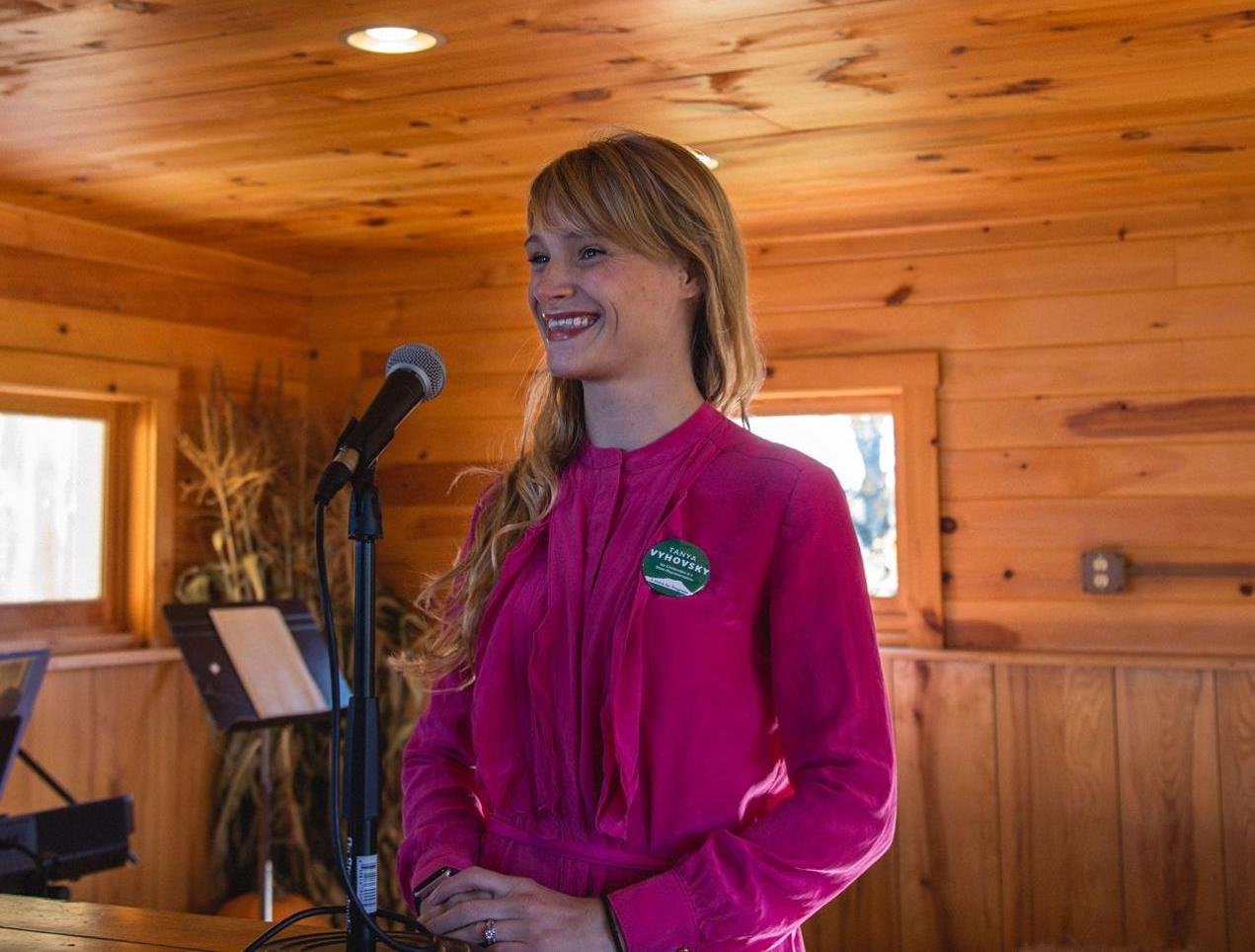
In November US socialist and Ukraine solidarity activist John Reimann interviewed socialist Vermont State Senator Tanya Vyhovsky (whom many of those reading this will have seen speak in the the UK, Belgium or Ukraine). You can watch the interview as a video on John’s Oaklandsocialist blog here. Thanks to him for allowing us to republish the transcript.
John Reimann
A new socialist movement is in the process of being born, and in that context, it’s important that that movement get off the ground on the proper footing. And one issue that has been enormously confusing for many socialists and young people in general in this country, has been the issue of the invasion of Ukraine by Russia. So we took the opportunity to talk with democratic socialist, Ukrainian American Vermont State Senator Tanya Vyhovsky.
John Reimann
We’re very happy to welcome Vermont State Senator Tanya Vyhovsky. In addition to being a mental health care professional, Tanya is a state senator in Vermont, and she’s she was endorsed by and has worked closely with Bernie Sanders in Vermont, and she’s a member of the Democratic Socialist of America, and is a democratic socialist. DSA in endorsing her said “in her time in office, Tanya has been a voice for organized labor, sentencing reform, reproductive justice, and has protected funding for Vermont’s after school programs for privatization.” So we are very happy to talk with you, Tanya. Maybe you could start by talking about some of the issues in Vermont that you’re dealing with so that people can get a sense of what’s happening in Vermont State politics?
Tanya Vyhovsky
Absolutely. I think the biggest issue that has been on people’s radar in the last year has been public education. There’s been a huge push, unfortunately, from Democrats and Republicans alike to move further toward into our voucher system and privatization, and so that has obviously been top of mind for our teachers, our communities. I am a strong proponent of public education and public dollars staying in public education. I think that’s been a surprise to a lot of people that I’ve spoken to, that in Bernie Sanders’ Vermont, there’s this huge push further towards privatization. We actually probably have one of the first voucher systems that has been in place for centuries, and there’s been a real push to expand that. So that’s certainly on people’s minds, and I know we’ll be coming back to fight for public education in the coming year, as we did last year. Of course, we are dealing with the issues that a lot you know, the whole country is dealing it with. We have a lot of ICE activity happening in Vermont. We have a affordability crisis, a housing crisis, a health care crisis. Vermont has the distinction of having the most expensive health care system in the country, and therefore in the world, and that’s been driving a lot of these other crises. You know, I just came from our joint pension oversight meeting, where we also looked at the Other Post Employment Benefits, which are health care, and how much that’s driving increases in the need for taxpayer spending. It’s also the biggest driver of our educational system spending. And so you know, when I hear people really upset about how expensive the public education system is it’s really important to point them to how expensive health care is, and really looking at ways that we can finally move towards a public single payer system. You know, if we continue on the trajectory we are on, it will collapse the whole economy. You know, the person who was presenting the, you know, pension meeting just now sort of even pointed to that. He’s like, you know, we’re predicting a 4.5% increase year over year. And it was brought up like, well, that’s really low. We saw a 30% increase this year. And he was like, Yeah, well, if that continues, it’ll make up the whole that’ll be all we spend anything on. I was like, Yeah, we got to do something about that. So, I mean, Vermont is sitting in the same place as so many places, and we’re certainly trying to do what we can to make lives better and more affordable for Vermonters, but we’re on the brink of collapse in a lot of our systems because we because of privatization and a lack of of treating public goods as public goods.
John Reimann
So in other words, Vermont is part of the United States. As part of that, United States is part of the world, and that’s why I know that you have spoken out on a number of different international issues. And for one thing, you’ve spoken out very strongly on the issue of Israeli genocide, for which I want to salute you. You’ve also spoken out on the issue of Ukraine. And first of all, maybe you could explain what brought you to that issue, why you see that issue is so important?
Tanya Vyhovsky
Well, that’s a that’s both personal and political. One of the reasons that I personally find it incredibly important is that I am Ukrainian American. I have friends and family in Ukraine, and so it is very personal, but from a political standpoint and a sort of global policy standpoint, imperialism is wrong no matter who is doing it. And when I look at, you know, all of the Western imperialism that I have spoken out against, and when I look at all of the imperialistic powers across the globe that are trying to take over other people’s lives and nations, Russia is no different. That is what’s happening there. We’re looking at Eastern imperialism, and Ukraine has such a long history of dealing with Russian imperialism. Particularly, I also look at sort of as as you’ve pointed out, Vermont is part of the world, so is Ukraine, and Ukraine is part of Europe. And I look at sort of the threat to global democracy if Russia is allowed to break international law, violate sovereign borders, violate the rights of people who live in Ukraine that, to me, is really detrimental to democracy and to just what is what to human rights.
John Reimann
What do you make of the argument that Russia invaded Ukraine because of the threat of NATO?
Tanya Vyhovsky
Well, I think it’s really an argument that is not looking at history, that is not looking at Russia’s actions, you know, in the near term history and the longer term history, or the things that are coming out of the mouths of Russians. We have heard from the Putin administration that nothing short of wiping Ukraine off the map is going to be acceptable to them. And that, to me, is more about genocidal behavior and erasing a a populace than it is about the threat of NATO. And frankly, nothing has created NATO expansion more than this Russian invasion of Ukraine. So I think it is a superficial argument that ignores history and present actions.
John Reimann
So you were recently in Ukraine. When when exactly were you there? And please talk about your visit.
Tanya Vyhovsky
I was there in August. I was meeting with leftists and socialists and union members, you know, people who are or were fairly critical of the neoliberal government in terms of their neoliberal policy, but recognize that in fighting for sovereignty and freedom, and in the midst of a war on that front, in many ways, they’re doing a reasonable job fighting for independence and sovereignty. And so I think I have to look through that lens of who asked me to go, who was I meeting with, but what I heard, you know, across the board, with pretty much everyone that I spoke to, is that the Ukrainian people are incredibly committed to their sovereignty. They do not believe that occupation is a peace deal, and that includes occupation of Crimea. It includes occupation of Donbas, and that to them, and the only just peace is for Russia to go home. And I spoke to people who came from the front line to meet with me and talk to me. And you know, what I heard from them is that if a deal is made where we are forced to accept occupation, there may be revolt within the armed forces, because that’s not what we’re fighting for.
Tanya Vyhovsky
I heard from the Ukrainian people, and from the Ukrainian Armed Forces members that I met with that they are tired, but they are not broken, and they’re not willing to give up to an imperialistic power. And I think again, looking in the short term, Ukrainians understand that if they are forced into accepting further occupation by Russia that that’s a pause button on on their invasion, not an end. We know that from the invasion of crime and occupation of Crimea, you know the sort of world stage said, “Okay, fine, but no more than Crimea.” And what happened is, years later, Russia came back for more because, of course, they did. We also know from the stories of people living in Crimea how horrific it has been to live under that occupation. And we know from the many centuries and even 1000 year long history of Ukraine, that Russian occupation of Ukraine has never led to good things for Ukrainians, which brings me back to my space. You know, occupation is a crime no matter who is doing the occupying and who is being occupied.
And so that’s a little bit of an overview of sort of what I heard. I heard lots of really amazing and thoughtful, forward thinking plans for a more socially just future for Ukraine that grounds the needs of the many over the needs of the few and over the needs of corporations. I really was impressed at how mature the left movement in Ukraine is, and how connected they are, working across different issue area and thinking beyond this war and this invasion and this occupation to a rebuilding of Ukraine that is more green, that is more grounded in social and economic justice, meeting with the feminist movement and talking with them about what they’re doing now to expand access to reproductive health care and to protect that in the future, and how they’re supporting women in the military and what their hopes are beyond the invasion for LGBTQ rights. And you know, it’s such a multi faceted, thoughtful way of “what are we doing right now in the face of this war, and what are our plans for a Ukraine that is not that doesn’t go back to the status quo of before the war, but that builds back stronger and more just.” And I heard from the feminists how they’re working with, you know, people who are doing more political work, and how they’re working with the unions. And there was just such an interconnectedness that I often see missing in in the US leftist movement, where we are often very fractured, very divided, very issue centric. And that was really heartening to see.
John Reimann
In my view, what’s happening is that Russia has declared war on the Ukrainian people.
Tanya Vyhovsky
Yes.
.John Reimann
And it’s not that different in principle, from what Israel has done in Gaza, the biggest difference is Gaza never had any air defense. So can you talk a little bit about what you saw there, the consequences of what Russia has done in Ukraine?
Tanya Vyhovsky
Obviously it varied depending on where I was. When I was in Kiev, the main portions of the city center, you know, a lot of the historic portions of the city center were fairly unscathed. But that doesn’t mean the signs of the war weren’t there.All the fountains were turned off because they’re saving money. All of the statues were wrapped and sandbagged, but you didn’t have to travel too far out of that main more like tourist and government center to find bombed apartment buildings. I was there just a few days after a major apartment building was bombed in Kiev, and we went, and you could still see all the pictures of the people who had died a few days ago, the children who had died a few days ago, and the memorial to them. And you know this one block of the apartment building was struck and was crumbling, big hole in the ground, and just a couple doors down in that same apartment complex, people were still living there. I talked to the students who can’t tolerate electric motorcycles, motorcycles that make a high pitched whirring sound because it sounds just like a drone strike. When I went to Kryvyi Rhi, which is much closer to the front lines. The children are learning in bomb shelters because it became too arduous to take them downstairs through every air raid, so they just moved the schools into bomb shelters. So children are learning underground, you know. And the teachers spoke about how difficult it is because you can hear the next classroom, because everything is so close together, and they have to teach in shifts so children aren’t in the schools as long because there just isn’t the space in the bomb shelters to teach. I visited a park in Kryvyi Rhi where in April, 19 people died, eight of whom were children. And that park is across the street from a kindergarten next door to a restaurant and surrounded by residential buildings. There is nothing that could possibly be deemed a military target, and yet the Russians used cluster munitions, which is a war crime, no matter who you use them against, to bomb this park on a Friday evening, killing 19 people, eight of whom were young children. And the memorial there was incredibly powerful.
I haven’t, prior to this trip, gone to see the recent sight of a war crime. And in Dnipro, it’s just, you know, again, everything is sandbagged, and they have these above ground cement bomb shelters on every corner where you can go very quickly if and when there’s an air raid. And just three hours after I left Dnipro, there were ballistic missiles that hit residential buildings. Then most of the city was on fire, so and Lviv, at the time, was a little less regularly struck. Although that has changed, the landscape has changed pretty significantly as Russia ramps up its daily attacks across the country. They have hit passenger railway trains. They have hit hospitals. They it is absolutely targeting civilians and creating a sense of terror. And that’s the little, the little bit that I got, but it has impacted the daily lives of every Ukrainian, every Ukrainian citizen.
My first night when there were nighttime air raids, and I spent some time in a bomb shelter. The next morning, I had a meeting at nine o’clock in the morning, and you know, the the air raid sirens went on. I think they went off around 2am and they went off, they were going off for or ongoing for about two and a half hours. I didn’t spend that whole time in the bomb shelter because I had sort of additional information that the air raid was about a kilometer and a half from where I was, and so that it was safe for me to go back up to my room. But I could hear the missiles falling. I could hear the air raids. And the next day, when I got up and I mentioned, you know, that I had been up late and it was kind of tired, the person who was meeting me say I must have slept through it, because it’s such a regular thing, you know. And I talked to Ukrainian who talked through how they make the calculation of, like, “okay, the air raids going off, like, am I going to go to work, or am I going to go to the bomb shelter, or do I have to take my kid to school? Or am I going to get my windows fixed that were blown out last week from the missile that hit across the street.” Just the calculation of how you live your day to day life when the sky actually is falling, because you can’t live in a state, in a constant state of panic and terror, you have life has to go on.
John Reimann
You’re a mental health professional. How would you say that that’s affected the collective psyche?
Tanya Vyhovsky
I experienced a country that is tired and but is not broken or beaten and has really united in innovative ways to be able to continue to push back against an aggressor with more people, more resources, and has been able to even in push into and take some of this into a more offensive push to get a tactical retreat. I spoke to people about the shift in internal Ukrainian thought and p olitics, again, particularly from from a leftist perspective, because of the war and the impact that that has had, but, but I think again it’s felt all over the country. I think children learning in bomb shelters, or children who have spent much of their their academic career fully remote because their their school buildings are too close to the front lines, or are now in occupied areas. And the long term impact of that trauma, and is generational I even think to my own family having learned a lot more about my grandfather’s work for Ukrainian independence when he was a young person. And, you know, through his his early to mid adulthood before he finally was forced to leave the country. And the impact that that has had on my dad, who was born in the United States, and even on me. This type of of broad scale trauma leaves a mark for for a long time and in lots of different ways. So I don’t think we’ll fully know the scope of the sort of collective impact until we’re on the other side of it, rebuilding and picking up the pieces.
John Reimann
So as you know, in the United States, there’s a broad, widespread movement on the left in support of Palestine. And a lot of those people, they don’t see the connection between Palestine and Ukraine, and in fact, they don’t really support Ukraine. How would you, how would you explain that?
Tanya Vyhovsky
It’s been really difficult to navigate that, because it’s quite clear to me. And again, it’s so incredibly personal, and I think it’s, sometimes I’ve explained it as kind of the opposite side of American exceptionalism. You know, there are the people who believe that the US is is the best in the world, and everything they do is amazing. And the flip side of that is the people who believe the US is terrible, and anything they’re involved in must be awful. And I think there’s some of that at play. I think there’s also a real lack of understanding about the long history between Ukraine and Russia, and between and the long history of Ukrainian occupation by Russia. I think for a lot of people in the United States, five years ago, they couldn’t point Ukraine out on a map. You know, that’s that’s a people who have been ignored. I mean, the number of times growing up when someone would see my name and be like, “Oh, is that Russian?” And I would say, “No, it’s Ukrainian.” And they would either stare at me funny or say, “oh, that’s the same thing” to which I woul often try to enlighten them that that’s actually really offensive, that Ukrainians do not see themselves as Russian, nor have they ever. So I think there’s a lack of understanding. There’s a lack of historical context. There is a lack of recognition that, while the United States may not be supporting Ukraine for altruistic reasons – I do not believe that they are – but that what is happening in Ukraine is genocidal, and it absolutely is occupation, and there are absolutely parallels (with Gaza). But I think it’s easier for people who are angry about US imperialism to look at what’s happening in Israel and Palestine and say, “well, the US is funding Israel and Palestine is occupied. Obviously, Palestine is where we should side,” whereas when you look at what’s happening in Ukraine, Ukraine is occupied, and there is Russian imperialism happening, but the US is in has been involved in supporting Ukraine. And so I think there’s a more difficult time for a lot of people without some of the that the additional context to draw the line and say this is bad. And I also think there is a contingent of the left that has this view that Russia is somehow a socialist utopia, which it is not. It is it is an authoritarian dictatorship that is hell bent on restoring it, the Soviet Union, and occupying all of those countries that were previous empire, even then, the old Soviet Union –
John Reimann
The Russian Empire.
I also think there’s a little bit of thinking of, you know, “the enemy of my enemy is my friend.” In that case, we should have supported Hitler during World War II, because the US was fighting Hitler. So when you came back from Ukraine, this was in August, did you have any meetings or discussions with your constituents and with, I’m assuming you have, like, a group of supporters you know, with them about Ukraine and your experiences there and so on. And how did that go?
Tanya Vyhovsky
So I’ve done a fair number of meetings. Actually on Saturday, I’ll be driving to Albany to do a to have a meeting to talk about my experience in Ukraine. So it hasn’t been simply my constituents. On Saturday, I’ll be driving to Albany New York, and there is in planning a Vermont local event. But we’ve all I’ve also done some stuff virtually so that larger populations can attend. I did an event with Haymarket Books. I’m trying to think where else I’ve done them, because it spends so many at this point.
John Reimann
How did that go with Haymarket books?
Tanya Vyhovsky
It was a really great conversation – that one was online. It was also really nice in that conversation that we were able to bring in the voices of Ukrainians living in the United States, as well as Russian dissidents that have fled Russia because of their leftist views in opposition to what Putin is doing. And it was a really dynamic conversation, and I think a really powerful one. I’m glad that I was able to do it, and I’m glad that these opportunities are continuing for me to be able to go talk to lots of different constituencies about this experience.
John Reimann
Did you run into any pushback there from people that we were talking about? And if so, how did that go?
Tanya Vyhovsky
Not really. There were definitely people who had critical questions but I didn’t find any of the pushback that we’ve been talking about in that space. And I’m not sure why. What I really found, actually, was people showed up really honestly, to have a dialog and to understand better what is going on. And that was the hope, you know, in going, part of going, you know, like I said, was personal to me, and was about building solidarity with the Ukrainian left on the ground in Ukraine, but part of that work was also coming back here and bringing those stories and bringing that experience. And I think the hope was that folks who truly wanted to understand would be the folks to come to the table. And so far, that has primarily been the been my experience in these having these discussions, and hopefully, when you know the Vermont local in person event is organized, that’ll be a similar conversation.
John Reimann
How do you see the association between Putin and Trump affecting opinion here on the issue of Ukraine?
Tanya Vyhovsky
It depends. I still run into the sort of really hard folks that I think are not going to change their mind, who historically have have been leftists who are like, “nope. On this one, Trump is right.” I’m like, “wait what?” But I do think for some that has shifted their thinking. You know that, “wait a minute, this horrible authoritarian dictator that has been elected in the United States is now aligned (with Putin)?” I think for some, it has made them question where they had before, and for some it has not
John Reimann
In Europe, they’ve had a number of tours of Ukraine that were organized with trade unionists, socialists and so on. Here, it’s more difficult because of the distance, but it is still possible. And I’m wondering what you would think of the possibility of organizing something like that.
Tanya Vyhovsky
I would absolutely love to organize something like that, and I’m very sure that my friends and contacts in Ukraine would welcome that, and would happily welcome a larger contingent of people. I think it would be incredible to to do something like that, and I would want to be thoughtful and careful to make sure we are taking people that want to build solidarity and don’t want to just go and recap, you know, cause anguish, because the Ukrainian people are dealing with enough with the bombs falling from the skies and but I think it would be absolutely incredible to pull together a group of open minded people to go and learn and have that type and do that type of solidarity work. I think at this point in time, whether we like it or not, we live in a globalized world, and the rise of global authoritarianism is in our face, and I don’t know that we beat that unless we are also building global working class solidarity. And where do we start that, but with the people right in the crosshairs
John Reimann
If the US government and others stopped sending arms to Ukraine, that would just open the door wide to the to the rest of the invasion. But that’s not enough. And so the question is, how can we build kind of worker to worker solidarity and build like a working class movement to support Ukraine and also support those in Russia who oppose the invasion, and as well as elsewhere. I mean, we know that throughout Europe now, Putin is having an influence. You know, both in developing support for Russia and. Link with building an extreme right wing movement such as the AfD in Germany. So I’d be interested in your thinking on that whole range of questions.
Tanya Vyhovsky
Absolutely. I think we build the worker to worker connections, you know, Union by union and worker by worker. I think a trip like what you’re describing is part of that movement and building those worker to worker connections. And there are various entities and people in the United States that are doing more of that kind of grassroots work. YI know the Ukraine Solidarity Campaign is currently doing fundraising for the Ukrainian nurses to get them the blood analyzers that they need in a couple of frontline hospitals so people don’t have to travel for that medical care. I know that the the electrical union has has done some work here in Vermont, and I believe regionally, to try and get some electrical supplies to Ukraine, because Russia continuously targets the electrical grid, which for most of Ukrainians, not only means that they don’t have light, it will mean that they don’t have heat and hot water. So so there some of that work is happening. And so I think it’s also connecting, you know, to that work that is happening.
In terms of Putin’s influence in in Europe, it’s not just the influence of building the far right movements like the AfD, they’re also starting to invade into other countries airspace. They’ve been doing it in Poland for quite a while, but in the last three or four months, we’ve seen invasions into the airspace of Romania, Belgium, the Nordics Poland, and a drone actually dropped in Poland that was partially loaded with explosives. That was not just an airspace invasion, actually. And that happened the day I left Ukraine. I was actually in Poland when that happened quite a bit from the border, further from the border than would be an accident. And we’re seeing this escalation into into more of Europe, which you know to points to something I’ve been saying since the full scale invasion of Ukraine, is that it if Ukraine falls, it doesn’t stop at Ukraine. It becomes world war III, because that will never be enough. And we’re already seeing those indications of that with these flagrant violations of other countries’ airspace. And again, I think we know this from history. You brought up Hitler earlier, but the Nazi authoritarian takeover and ultimate invasion and occupation and the genocide started because of economic distress. And so I think we also need to recognize that we need to take care of the the material economic needs of everyday people if we’re truly going to stop authoritarians from taking over,
John Reimann
In other words, an international workers movement, yes, workers interests, economically, yes. And also, you can’t fight for those interests if you have fascist and semi fascist movements developing or taking over, in the case of Russian invasion of Ukraine,
Tanya Vyhovsky
Exactly. One of the arguments that I sometimes have heard in opposition to supporting Ukraine is, “oh, they have a neoliberal government.” They do, but there is no leftist Ukraine if Russia has has taken over, and of course, there are also people on the left who are just spouting Russian propaganda, who are spouting about Nazis in Ukraine. Are there Nazis in Ukraine? Yeah, there’s Nazis everywhere. But in the election cycle before the full scale invasion, not a single one of them won their election. They got less than 2% of the vote. Meanwhile, here in the United States, we have a wannabe Nazi in the White House! There’s been such a broad scale push of this Russian propaganda about denazifying Ukraine, and that’s all it is. It’s Russian propaganda.
John Reimann
Coming from Putin, who probably has closer ties to actual Nazis than just about any other head of state in the world!
Tanya Vyhovsky
Yes, absolutely. Let’s not forget that Vladimir Putin is former KGB. That is, he’s working from a set of rules that are not about democracy, that are not about the rights of people, that are not about moving away from. Nazi like regimes,
John Reimann
America first, which is a fascist group, supports Putin.
Tanya Vyhovsky
We are in a an existential battle in the United States for democracy. And again, that is happening all over the globe. And so what I’d really encourage people do is to open their minds, to connect with someone from somewhere else who is grappling with something, and learn from them. You know that’s one of the things that has really struck me about a lot of the conversations in western leftist spaces about Ukraine, is there are no Ukrainian voices in those discussions, and there are a wonderful contingent of Ukrainian leftists that are fighting for a left socially just Ukraine, and they cannot do so if they are under Russian occupation. So I would, I would certainly encourage people to open their minds and their hearts to that experience. And I would love to work on planning a larger group of us leftists and US trade unionists to join me the next time I go to Ukraine.
John Reimann
I want to conclude with this issue: In your experience in Ukraine, and from what you know in general, how important is it for Ukraine to continue to receive arms from the United States and other countries?
Tanya Vyhovsky
I think it’s critically important for Ukrainian sovereignty and for any type of just end to this invasion. And I also think it’s critically important given some of the the points from earlier, how Ukraine sits in between Russia, Europe and potentially World War Three, I think it’s incredibly important. The US has the largest military power in the world, and certainly I would agree that the US needs to reduce military spending and needs to invest in its people, and it’s what they have offered to Ukraine is a drop in the bucket compared to what they are spending everywhere else. But I think this is a critical humanitarian issue and a critical global peace issue.
John Reimann
So then, how do you answer people that say, “oh, you know, I agree with you about Putin. He’s a horrible guy. The invasion is a crime, all this sort of thing, but I just don’t…. I just want to see an end to war, and I don’t believe in doing anything to support the US military industrial complex. And so therefore I’m against sending arms to Ukraine, but I support Ukraine.” How do you answer that?
Tanya Vyhovsky
Well, I think it’s an incredibly simplistic view. Allowing an aggressor to win, to get what they want, doesn’t create lasting or just peace. If we allow Russia to illegally invade, and we have this idea that if we just don’t fight back, that that’ll create peace, that’s I mean, it’s crazy. If Russia gets what they want, they’re going to keep invading, which is going to spread war and destruction. And so I I would also consider myself someone who is opposed to war, someone who would like to see global peace. I just recognize that allowing a an invader to win isn’t going to create global peace. It is. It is going to create a spread of that invasion and imperialism, you know. And even allowing an invader to occupy isn’t going to create peace. We know that from Palestine, allowing Israel to occupy Palestine for 75 years. That was not peace for the Palestinian people. That was not justice for the Palestinian people. And that’s led to where we are now, where Israel is doing a full scale genocide, and that is not peace. If people believe that that’s peace, I don’t think they’re actually pacifists. I don’t think they actually are looking for peace.
John Reimann
So would you agree that those who say that, no matter how much they say that they’re against the invasion and against Putin, what they’re really doing is calling for the conditions that will enable the victory of that invasion?
Tanya Vyhovsky
Yes, I would say that,
John Reimann
There you have it. Either we believe in international working class solidarity or we don’t. Support Ukraine!
 Ukraine Solidarity Campaign (Кампанія Солідарності з Україною)