Republished from Educators’ Fightback blog. Thanks to the comrades. We will be encouraging Ukraine solidarity groups and networks in other unions to write similar updates.
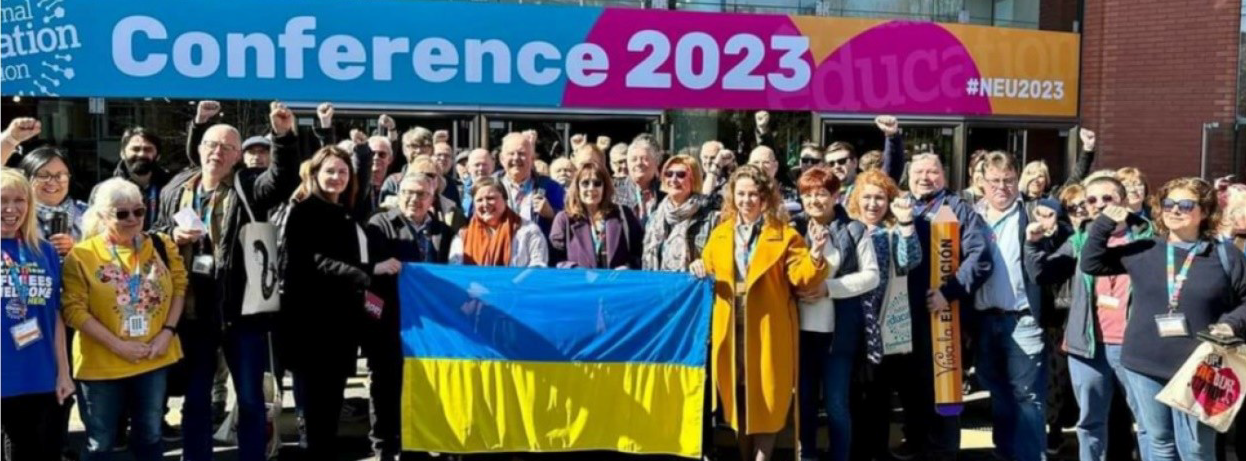
(Image above: delegates at National Education Union conference 2023 with representatives of the FPU-affiliated Trade Union of Education and Science Workers of Ukraine)
As background to this blog post, we are reproducing below a blog post published by the Socialist Educational Association last April, because we think it gives a fair account of how we got to where we were back then. We also agree that the actions of the Stalinists and SWP at the last conference was “an attack on the NEU’s commitment to international solidarity work”.
But what has happened in the ten months since?
Readers and contributors to this blog have worked with others in the NEU’s Ukraine Solidarity Network, bringing together people of a range of political views – from Workers’ Liberty and people close to us to those who might disagree with much else that we say. The network is organised simply around the idea of building trades union solidarity with Ukraine; trades union solidarity matters because Ukraine needs all the support it can get to fight off the Russian war and because trades unions in Ukraine need support.
The network has won districts to affiliate to the Ukraine Solidarity Campaign (with more NEU districts affiliated than from any other union) but focused mostly on organising within the NEU for practical solidarity.
The network has organised over the last ten months to get the policy commitment from the NEU’s 2025 conference that was blocked in 2023 and 2024. It has drawn up and circulated a motion for the 2025 conference and eleven NEU districts submitted it – making it the seventh most popular motion out of the 133 submitted. The NEU is now in the midst of its ‘priorities ballot’, through which districts decide which submitted motions go forward for debate. So far – just over half way through the prioritisation period – thirteen districts that we know of have voted to prioritise the network’s motion, guaranteeing it a place on the conference agenda. The ‘opposing’ motion on Ukraine, representing the views of those who worked hard to block solidarity at the last two conferences, was submitted by just two districts. (Interestingly, that motion, whilst flawed in ignoring the free trades unions of Ukraine and giving no solidarity to Ukraine’s efforts to defend itself, is an improvement under pressure on their ‘delete all and insert’ amendment last year which explicitly endorsed the ‘Trump’ line of the big powers pressurising Ukraine to surrender).
So the network has taken seriously the detailed work for NEU conference, but it hasn’t left it at that. It has also worked to organise from the ground up the solidarity action that the union nationally should be organising. The network has organised links with Ukrainian education trades unions, fund raising, support for refugees, school twinning and so on.
As an example, the absense of the NEU nationally organising a solidarity delegation to Ukraine, the network has done it itself, with four NEU Districts sending members on a self-organised delegation to Lviv to show others in the NEU that it can be done, and how. (See posts on this blog at the start of November). Those who went – all active members of the network, some contributors to this blog – have reported back to their own districts and regions as well as others, as part of countering the pro-Putin propaganda and ‘campist’ lines that’s are still being pushed in the unison by some. ‘Want to discuss Ukraine?’, we say, ‘then do it together with Ukrainians, and listen to what they say’. ‘Make direct links with schools and trades union in Ukraine’.
The trades union solidarity conference taking place on February 15th is just one more part of that work. This is a way of bolstering the support within the NEU, planning for more and more impactful actions, and learning with and from activists in other unions. In many ways, the NEU Ukraine solidarity network is an example for other unions to learn from too – in their own ways, of course, as suits the particular organisation of each union.
The network can be contacted at neuukrainesolidarity@gmail.com
‘The NEU and Ukraine’, from the April 2024 post on the SEA blog Education Politics.
The National Education Union gives a high profile to international solidarity work. There are different views in the union about aspects of that work but its high profile is something many NEU members are proud of, and is for many an important part of the union’s identity. The NEU organises a network of local ‘international solidarity officers’, holds an annual international solidarity conference, sends delegations abroad, and provides considerable financial support for the Steve Sinnott Foundation, named after a former general secretary of one of the NEU’s two predecessor unions, the NUT.
Undermining that reputation, NEU Conference has for a third time ended without a policy about the Russian invasion and war against the people of Ukraine.
Since the invasion NEU local districts have made direct links with schools in Ukraine, raised thousands of pounds for generators and other equipment, and hosted children and students having respite in the UK. They have organised for Ukrainian trades unions to address district meetings remotely, and in person at Conference fringe meetings.
NEU activists have publicised the plight of children and trades unionists in the occupied territories, circulated information about schools forced underground in cities like Kharkiv, and responded to the call from education trades unions for solidarity and for vigilance against the risk of western governments abandoning Ukraine or pushing for surrender – a risk that would grow hugely in the event of a Trump victory in the USA.
But there is still no policy at national level.
After more than two years of schools being destroyed, power and water infrastructure repeatedly damaged, trades unionists being murdered in the occupied areas and children being abducted into Russia, the NEU conference has not even called for withdrawal of Russian troops.
This weakness was expressed at the last TUC congress, when the NEU delegation actually abstained on solidarity, at odds with the vast majority of UK trades unions, all education unions in Europe, and the education trades unions organisation ‘Education International’.
The 2024 NEU conference was an important opportunity to set that right, and to bring conference policy into line with the work on the ground, multiplying the effect of that work many times over.
That prospect started well. A large number of NEU districts submitted motions on Ukraine – all being for solidarity. It was high in the NEU priorities ballot, putting it second in the international section after the situation in Gaza. The NEU’s official international solidarity fringe meeting heard from Olga Chabaniuk (Vice President, Trade Union of Education and Science Workers of Ukraine) about the war and occupation. Julien Farges, (Head of International Department, SNES-FSU, France) and Maike Finnern (President, German Education Union) gave their solidarity in their speeches at the same meeting.
A conference fringe meeting held by the ‘NEU Ukraine Solidarity Network’ attracted over 150 conference delegates hearing again from Olga as well as Kateryna Maliuta, international officer from the same union, John Molony of the PCS, and John McDonnell MP speaking on behalf of the Ukraine Solidarity Campaign. Two young Ukrainian refugees, Iryna Rura and Daniil Zavalniuk, both spoke powerfully about their experiences. Iryna spoke about living for a year under Russian occupation in Kherson. The meeting was chaired by Labour peer Christine Blower, a former general secretary of the NUT and a member of the SEA.
It was clear that the support among delegates for passing policy was easily sufficient for the solidarity motion to pass, in contrast to the two previous years. Support for Ukraine had been expressed also at other fringe meetings and by Palestinian representatives present. A fringe meeting held by ‘Stop the War’ was noticeably smaller than the Ukraine Solidarity fringe, even though its focus was Gaza, and around a third of the meeting expressed their opposition to StW’s call for the big western powers to use their might to pressure Ukraine into surrender by withholding arms.
But it was still not to be. Although no motion had been submitted opposing Ukrainian solidarity, there was a ‘delete all and insert’ amendment which – unusually for ‘delete all and insert’ – was placed as amendment one by the conference arrangements committee, whose chair later seconded the very amendment. Under NEU conference rules, delegates had to debate this amendment as soon as the main motion had been proposed and seconded. Shortage of conference time (as a result of some time-wasting earlier in the agenda) meant that no vote was taken on the solidarity motion. Unusually for a labour movement conference, the NEU doesn’t just curtail debate when time runs out, but drops the votes too, making itself highly vulnerable to time-wasting tactics from minorities who know they will lose a vote.
The Ukraine debate ended with no vote, with the final speaker denouncing the situation and what she termed a ‘wrecking’ amendment as ‘unworthy of this union’.
There is undoubtedly a genuine difference of view in the NEU about Russia’s war on Ukraine. There is a discomfort for a minority of activists in appearing, in Britain, to take the same stance as our own government on opposition to Putin’s war. There is sufficient pro-Putin misinformation circulating on social media (and through political groups that see the world in geo-political rather than class terms) to reinforce that discomfort. What is undoubtedly unworthy – and an attack on the NEU’s commitment to international solidarity work – is that such discomfort has been used to oppose not only Ukraine’s right of self-determination and to self-defence, but even the basic idea of NEU districts making links with education trades unions in Ukraine, an absolute core of trades union solidarity. It is to the NEU’s credit that Olga Chabaniuk was invited to address the union’s official international fringe, but the policy to extend this in districts – to ‘support districts making direct links with trades unionists in Ukraine, including Ukraine trades union speakers for local meetings’ was opposed by that first amendment.
Direct links and solidarity would undoubtedly have been supported by conference had a vote been taken.
The NEU Ukraine Solidarity Network is now working to pull together the growing number of NEU districts that are implementing this policy on the ground. We hope that from this conference every district will hear from Ukrainian trades unionists and join the efforts of practical solidarity. It is to be hoped that more and more of those who focus on an appearance of ‘being on the same side as the UK government’ will be able to take a wider, internationalist, view by listening to what Ukrainian trades unionists themselves are saying.
This work on the ground can help to ensure that the NEU’s pride in its reputation as an internationalist union can maintained, and practical solidarity can be made with education trades unionists fighting for their survival.
 Ukraine Solidarity Campaign (Кампанія Солідарності з Україною)